
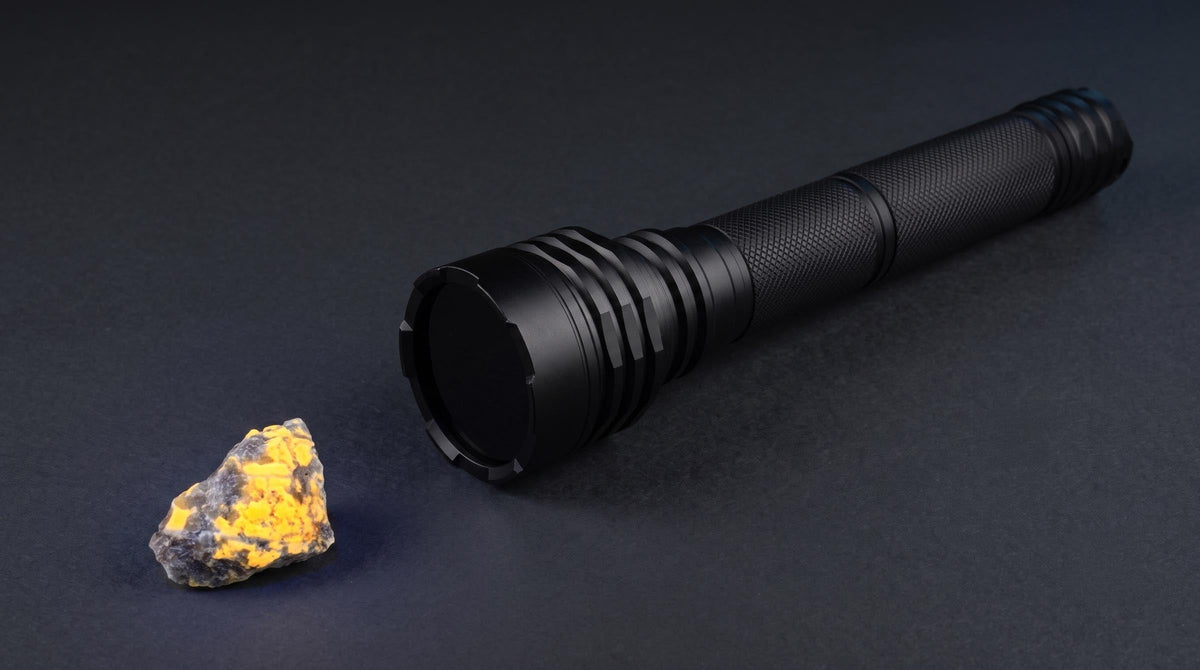
Best UV Flashlight for Yooperlites: What Actually Matters
When you are walking a dark shoreline, a Yooperlite can look like one ordinary gray rock among thousands. The right UV flashlight helps its fluorescent sodalite stand out soon enough for you to stop, confirm the reaction, and make the find.
The Goal Is a Visible Rock, Not a Visible Beam
A cheap purple blacklight will spark a reaction on a rock sitting right in front of you. It’s a lot less helpful when you’re walking a dark beach, scanning wet gravel, trying to catch one glowing rock among a thousand ordinary ones. The best Yooperlite light isn’t the one that makes the beach look purple. It’s the one that makes the rock jump out while you’re mid-search.
Why Many Hunters Choose Filtered 365nm
Start with wavelength and contrast. Yooperlites can fluoresce under longwave UV, and many hunters prefer filtered 365nm because it produces less visible purple spill than a typical 395nm blacklight. That darker background can make the orange-yellow reaction easier to notice in mixed gravel. A 395nm light can still reveal Yooperlites at close range; actual visibility depends on the individual rock, output, distance, darkness, and beam.
Learn more: 365nm vs 395nm UV Flashlights: What’s the Difference?
Choose Coverage for the Search
Size is where Yooperlite hunting shows its hand. A compact light like the Scout 365nm is handy for confirming a rock once it’s in your palm, but the actual hunting — scanning ahead as you walk a shoreline, sweeping across gravel and rock piles — wants coverage and sustained output. That’s the Atlas 365nm’s lane. A pinpoint beam makes you crawl; a wide, weak one spreads too thin to spark much. You want enough spread to search efficiently and enough punch to still light the target.
Learn more: Best UV Flashlight for Fluorescent Minerals and Yooperlites
Ask About Useful Distance
Distance matters more than sellers admit. You’re often scanning the ground several feet ahead while walking, not pressing the light to each rock. The real spec isn’t how far the beam travels — it’s whether a Yooperlite still glows clearly at the range you’re searching from, which depends on the light, the surface, and how dark it is. Treat vague “long range” claims with suspicion until someone tells you what still fluoresced, and at what distance.
Learn more: Long Range UV Flashlights: What Actually Matters at 10, 20, 30, and 40 Feet
How to Search
Technique is mostly patience. Hunt when it’s genuinely dark. Move slowly and sweep the beam in manageable sections instead of waving it everywhere. Watch for the rock’s reaction, not the beam, and when something glows, check it from a couple of angles — labels, trash, and other materials fluoresce too, so not every glow is treasure. The light finds candidates; you confirm the catch.
Carry UV as Part of a Safe Night Kit
And since this happens at night, near water, on cold and uneven ground, the flashlight is one piece of the kit, not the whole plan. Know your footing, watch the waves and the weather, respect private property, and don’t make a UV light your only light when you also need to see where you’re walking. Bring a normal flashlight or headlamp for that, and keep the UV off people’s eyes.
A Simple Yooperlite Search Plan
Wait for full darkness and use a white light to move safely.
Sweep the UV beam slowly across manageable sections of shoreline or gravel.
Confirm promising reactions from another angle and inspect the rock in hand.
Bottom line: choose a longwave UV light that gives you clean contrast, useful coverage, and enough output at your working distance. Scout is suited to close confirmation; Atlas is built for scanning shoreline and gravel as you move.